

The Boldness of a Bride without Dowry
In Menander’s One-line Opinions (Γνῶμαι μονόστιχοι), we find the following aphorism:
A bride without dowry has not freedom of speech (παρρησίαν). Continue reading “The Boldness of a Bride without Dowry”
In Menander’s One-line Opinions (Γνῶμαι μονόστιχοι), we find the following aphorism:
A bride without dowry has not freedom of speech (παρρησίαν). Continue reading “The Boldness of a Bride without Dowry”
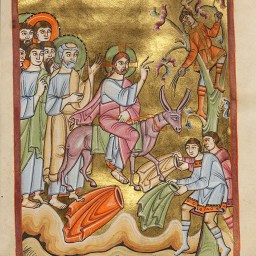
A Meditation on Palm Sunday and folly over at the Blog of the Emerging Scholars Network. Thanks for featuring my work again folks! Continue reading The Perfection of our Praise: Reclaiming our Inner Folly on Palm Sunday– A Post on the Emerging Scholars Blog
In the Phaedo, Socrates’ friends gather round him on his last day. He is about to drink hemlock, but they wish to be reassured once again that the soul does indeed live on. They are full of fear that in death the soul meets its end. What would such a proof look like? How can one demonstrate the immortality … Continue reading Experimental Hope
There was a gardener who filled his garden with plants of all kinds that he might have good food to eat throughout the long year. In that garden were fruits and vegetables, nuts, herbs, spices, and vines. He hedged his garden about with strong walls to protect it, and to each plant he gave water … Continue reading Two Fruit Trees
As I return to sameandother after a brief hiatus, I return with uncertainty, but also with a new hope (no Star Wars pun intended). My goal has always been to write a weekly post, but in the last few months, it was impossible to deliver on this. I wasn’t even able to fill the interval with jokes … Continue reading In the Fullness of Time
Parenthood in A Brave New World is considered obscene. Motherhood, fatherhood, and family-life are looked upon, not only as antiquated, but as shameful. There is a powerful logic at work in the novel, a logic which is at work in our own culture. When sex ceases to be linked with marriage or reproduction, our bodies and our bodily existence can … Continue reading Squeamish About Our Bodies (The Third of Three Meditations on A Brave New World)
Social conditioning in A Brave New World (coupled with genetic and pharmacological engineering) succeeds in eliminating nearly all conflict, but it also undermines certain fundamental elements of a truly human polis. Ironically, in this highly uniform society, it is unity which is undermined most of all. This is because social unity, understood as a communion of persons, cannot be achieved merely … Continue reading Unity vs. Uniformity (The Second of Three Meditations on A Brave New World)
To be a disciple is fundamentally to be a learner. But while a geometry student submits his mind to a proof or theorem, a learner of Christ is called to submit his whole being to God. And while the student may come to internalize a truth, the disciple can come to embody God’s presence. This is because both Learning and discipleship happen through a process of poetic formation. In … Continue reading The Poetics of Faith and Learning, Part 4
In a post on sexuality, I tried to describe reproduction in light of the double bond of love which it uses to weave the human family together. But it must be noted that the tapestry of history and of humanity is tangled and ravaged by death, resentment, violence, and rejection. One need only think of the difficulties of a … Continue reading Platted and Woven, Part 2: A New Sort of Enmity
When the Hairy Hooligans are ambushed aboard their ship, their captors announce a plan to execute Stoick, the head of the viking tribe as well as his heir. It is at this moment in Cressida Cowell’s How to be a Pirate (from her How to Train a Dragon Series) that Hiccup steps forth in heroic loyalty to his father. … Continue reading On the Power of Asking Questions






 Same & Other