

The Great Men of Dickens
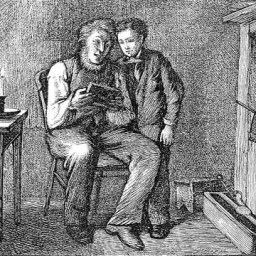
There is not much I can say about Joe Gargery of Charles Dickens’ Great Expectations or about Mr. George of Bleak House. The goodness and simplicity of these men makes them shine out like stars on a cold winter’s night. Only, these stars give warmth. I will make only the conjecture that Dickens saw in these men, as … Continue reading The Great Men of Dickens
Why Ideas are not Bodies
Here are two arguments why ideas are not themselves bodies. First, before God created, he knew all that he would make. If ideas are bodies, than bodies would have existed in God from eternity. Second, we can imagine a closet filled with clothing (shirts, pants, etc.). The closet does not know what is in it. … Continue reading Why Ideas are not Bodies
Mr. Spun’s Truly Terrible Awful Jokes: #32
How do we know man is innately mathematical?
Continue reading “Mr. Spun’s Truly Terrible Awful Jokes: #32”
Sanctification as Unity in Brothers Karamazov
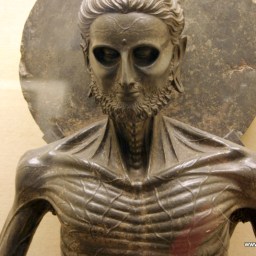
Father Ferapont does not need to eat bread; he can live off of mushrooms. Unlike the other monks of his monastery, he keeps the true fast. He is impervious to the desires of the flesh. In Brothers Karamazov, this monk represents the terrible danger of spiritual strength–a self-sufficiency which masquerades as holiness. Through Ferapont, Dostoevsky depicts … Continue reading Sanctification as Unity in Brothers Karamazov
Genus in the Particular
A dog is a kind of animal. But the species dog cannot be included in the genus animal–that is when we consider genus not as a mere classification but as a a way of understanding a particular nature in the Aristotelian sense. If we did include dog in the genus animal, every animal would have … Continue reading Genus in the Particular

Smaller than the Smallest Angle (formed by straight lines)
The angle a tangent line forms with the circumference of a circle is is least possible angle made with a straight line from that point of tangent (tangent line EA in the image). This is demonstrated in Book III, proposition 16 of Euclid’s Elements. The angle formed by the tangent is also known as a cornicular or … Continue reading Smaller than the Smallest Angle (formed by straight lines)

The Terrible Fatalism of Gambling and the Providence of God
Richard Carstone in Charles Dickens’ Bleak House is a quintessential gambler. A promising young man who holds the heart of a lovely young lady, who is supported by a wealthy benefactor, and who is surrounded by well wishers, he is only in need of a bit of steady application. But in this he fails because he is … Continue reading The Terrible Fatalism of Gambling and the Providence of God

The Fancy Chef: On the Subject of Science
An excerpt from a recent paper: Incidental being is not an object of science because it is neither always and necessarily in the same condition, nor even for the most part so.[1] The essential stability of knowledge depends upon an essential stability of being. The analogy used to show this is a remarkable example of … Continue reading The Fancy Chef: On the Subject of Science

On Whether God Loves the Individual or Christ
Does God see us and love us or does he instead see only Christ? It is often preached that God looks not to our sins, but to the merits of Christ in whom he is well pleased. Or, that when God looks at those in Christ, he sees not them, but Christ. This might suggest … Continue reading On Whether God Loves the Individual or Christ

