Unity vs. Uniformity (The Second of Three Meditations on A Brave New World)

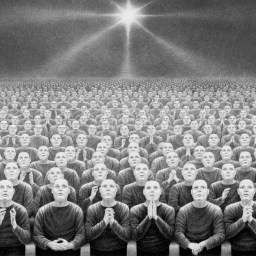
Social conditioning in A Brave New World (coupled with genetic and pharmacological engineering) succeeds in eliminating nearly all conflict, but it also undermines certain fundamental elements of a truly human polis. Ironically, in this highly uniform society, it is unity which is undermined most of all. This is because social unity, understood as a communion of persons, cannot be achieved merely … Continue reading Unity vs. Uniformity (The Second of Three Meditations on A Brave New World)


The Failed Promise of the Enlightenment (The First of Three Meditations on A Brave New World)

The success of the political order in A Brave New World comes at the price of social and personal maturity. Yet, it is a price the controllers and engineers of that society willingly pay, making the very success of their social experiment a failure. Remarkably, the failure of this system finds its origin in values first codified during the Enlightenment. It was during … Continue reading The Failed Promise of the Enlightenment (The First of Three Meditations on A Brave New World)

Literary Personal Ads

Personals In search of May-September romance in which the occasional scolding is enjoyed. Can share space with hypochondriac father-in-law. Wealthy Land Owner willing to burn his past down to the ground for love. Strong-Man hoping to be blinded by beauty. In need of grooming Book in search of Puritan-Type to worship its every word. Parallel lines in hope of … Continue reading Literary Personal Ads

The Poetics of Faith and Learning, Part 4

To be a disciple is fundamentally to be a learner. But while a geometry student submits his mind to a proof or theorem, a learner of Christ is called to submit his whole being to God. And while the student may come to internalize a truth, the disciple can come to embody God’s presence. This is because both Learning and discipleship happen through a process of poetic formation. In … Continue reading The Poetics of Faith and Learning, Part 4

The Poetics of Faith and Learning, Part 3

We saw that the study of Euclid can serve as an archetype of contemplative learning and that learning is itself personal and Trinitarian. Let’s slow down now and reflect upon how this might influence our own learning and teaching. Further Up and Further In Personal learning implies depth, depth which emerges in dialogue, and this requires more than frozen facts. Dialogue involves speech. … Continue reading The Poetics of Faith and Learning, Part 3